TÜBİTAK UZAY Connects Satellite Subsystems and Mission Operations
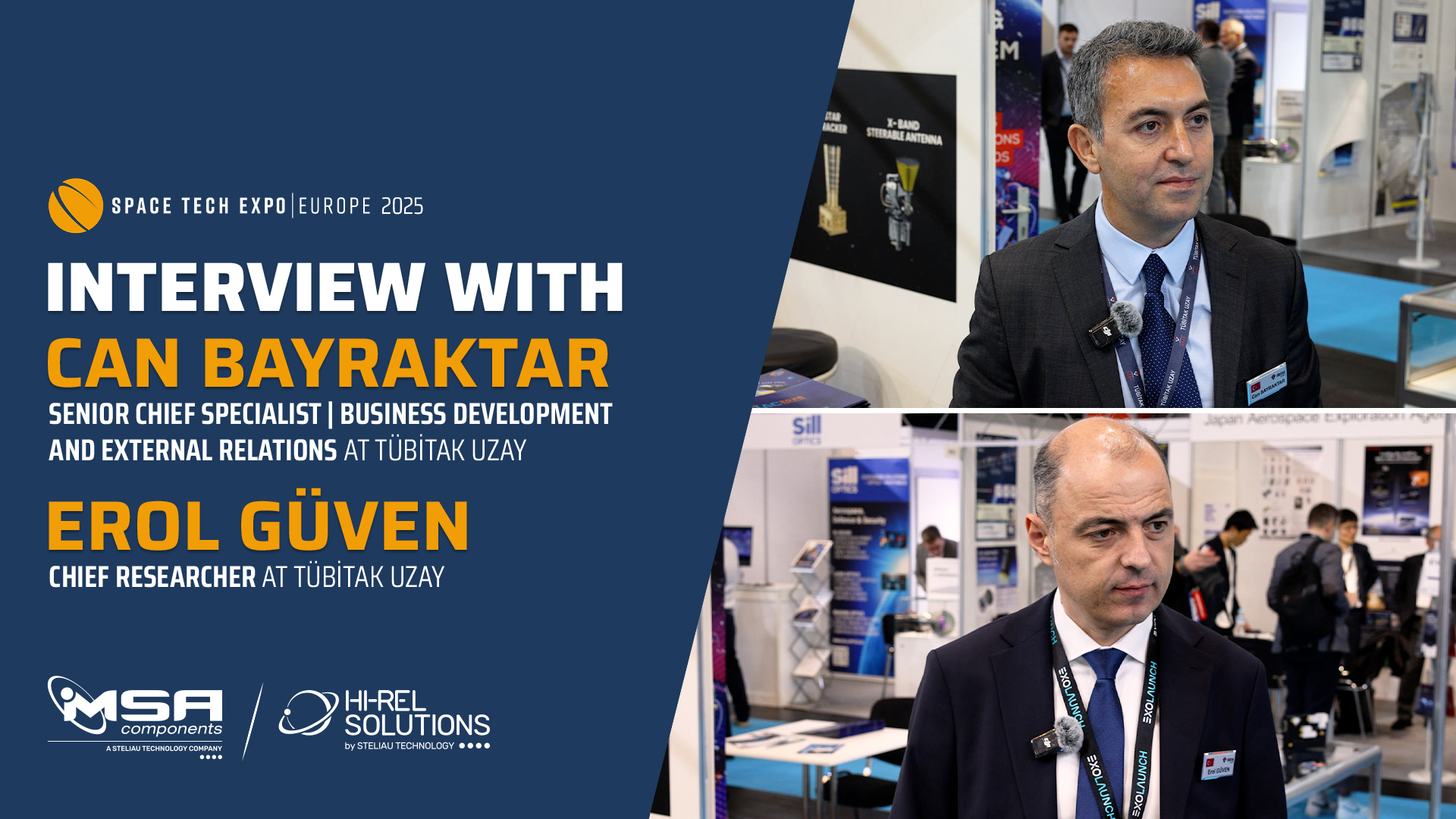
How do satellite hardware, integration and mission operations fit together? At Space Tech Expo Europe 2025, we spoke with Can Bayraktar and Erol Güven of TÜBİTAK UZAY about these connections. The Turkish research institute develops satellites and subsystems and has its own assembly, integration and testing facilities, alongside optical research laboratories.
In the interview, they present examples from the portfolio: a steerable X-band antenna, a star tracker, electric propulsion and platforms for different mission profiles. Software for subsequent operations completes the overview. The conversation shows how closely these activities are connected in spacecraft development.
Onboard Communications and Attitude Determination
The electromechanical steerable X-band antenna supports payload data transmission from low Earth orbit. Its mechanism points the antenna towards the ground station, illustrating a specific interface between the satellite and the ground segment.
The star tracker presented in the interview supports spacecraft attitude determination. The product description covers optical sensor data processing and delivery of the calculated orientation to the flight computer. Communications and attitude determination serve different functions, while both need to fit the overall system architecture.
Electric Propulsion and Platforms for LEO and GEO
TÜBİTAK UZAY’s HALE family comprises Hall effect thrusters. Its electric propulsion overview describes uses including orbit raising, station keeping and deorbiting. Propellant supply and power processing units are also part of the propulsion system.
The interview references the İMECE Earth observation satellite in low Earth orbit and the TÜRKSAT 6A communications satellite in geostationary orbit. These mission examples show why subsystems need to be considered in the context of the platform and its particular requirements.
An Update on the Lunar Mission
The 2025 discussion also covers Türkiye’s planned lunar mission and the deep-space platform developed for it. Subsequent project developments provide useful context when revisiting the interview today.
In a recent institute announcement, TÜBİTAK UZAY reports completion of manufacturing, assembly and integration of the lunar spacecraft and its transition to system-level environmental testing. Its programme page identifies the second quarter of 2027 as the target launch period.
Mission Operations as Part of Development
The interview concludes with ground operations and mission planning. Developed by TÜBİTAK UZAY, TstarGO brings together functions including command and control, orbital dynamics, payload configuration and simulation. The overview therefore extends from individual equipment to the tools used for operational missions.
For engineering teams, the discussion offers a useful reason to consider interfaces and operational requirements early, alongside the relevant subsystems. Thank you to Can Bayraktar and Erol Güven for sharing their work and for the technical exchange at the exhibition.
Discuss Space Electronics with MSA
MSA Components and our colleagues from Hi-Rel Solutions by Steliau Technology will attend Space Tech Expo Europe 2026 in Bremen from 17 to 19 November. To discuss component selection and requirements for your space electronics, meet our team in Hall 5 at Booth F11.
TREAMS measures component cleanliness and outgassing in vacuum Thin residues from oils, lubricants or cleaning agents can remain on components after cleaning and affect subsequent steps such as coating or…
TÜBİTAK UZAY Connects Satellite Subsystems and Mission Operations How do satellite hardware, integration and mission operations fit together? At Space Tech Expo Europe 2025, we spoke with Can Bayraktar and…
Omnetics High-Speed Nano-D for Compact Space Electronics Selecting interconnects for space electronics means considering electrical transmission performance alongside mechanical demands. A compact interface needs to fit the equipment and carry…
From Launch Vehicles to Satellite Constellations: Advanced Composites in Space From launch vehicles and satellite structures to solar array panels, carbon fibre composites play an important role in modern space…
From component selection to design-in: our sales team advises you in person, by phone, video call or on site. We will set aside 30 minutes for you.
How
Phone, video call or on site
Where
At MSA in Attendorn or at your premises
Duration
Up to 30 minutes
Response
Within 1–2 working days
PERSÖNLICHE BERATUNG
Sprechen wir über Ihr Projekt
Von der Bauteilauswahl bis zum Design-in: Unser Vertriebsteam berät Sie persönlich, telefonisch, per Videokonferenz oder vor Ort. Wir nehmen uns 30 Minuten Zeit.
Wie
Telefon, Video oder vor Ort
Wo
Bei MSA in Attendorn oder bei Ihnen
Dauer
Bis zu 30 Minuten
Rückmeldung
Innerhalb von 1-2 Werktagen
Application Form
Bewerbungsformular
Produktinformationen anfordern
Interessieren Sie sich für dieses Produkt? Geben Sie unten Ihre Daten ein, und wir melden uns bei Ihnen mit Informationen zu Preisen, Verfügbarkeit und technischen Details.
Request Product Information
Interested in this product? Fill in your details below and we'll get back to you with pricing, availability, and technical information.