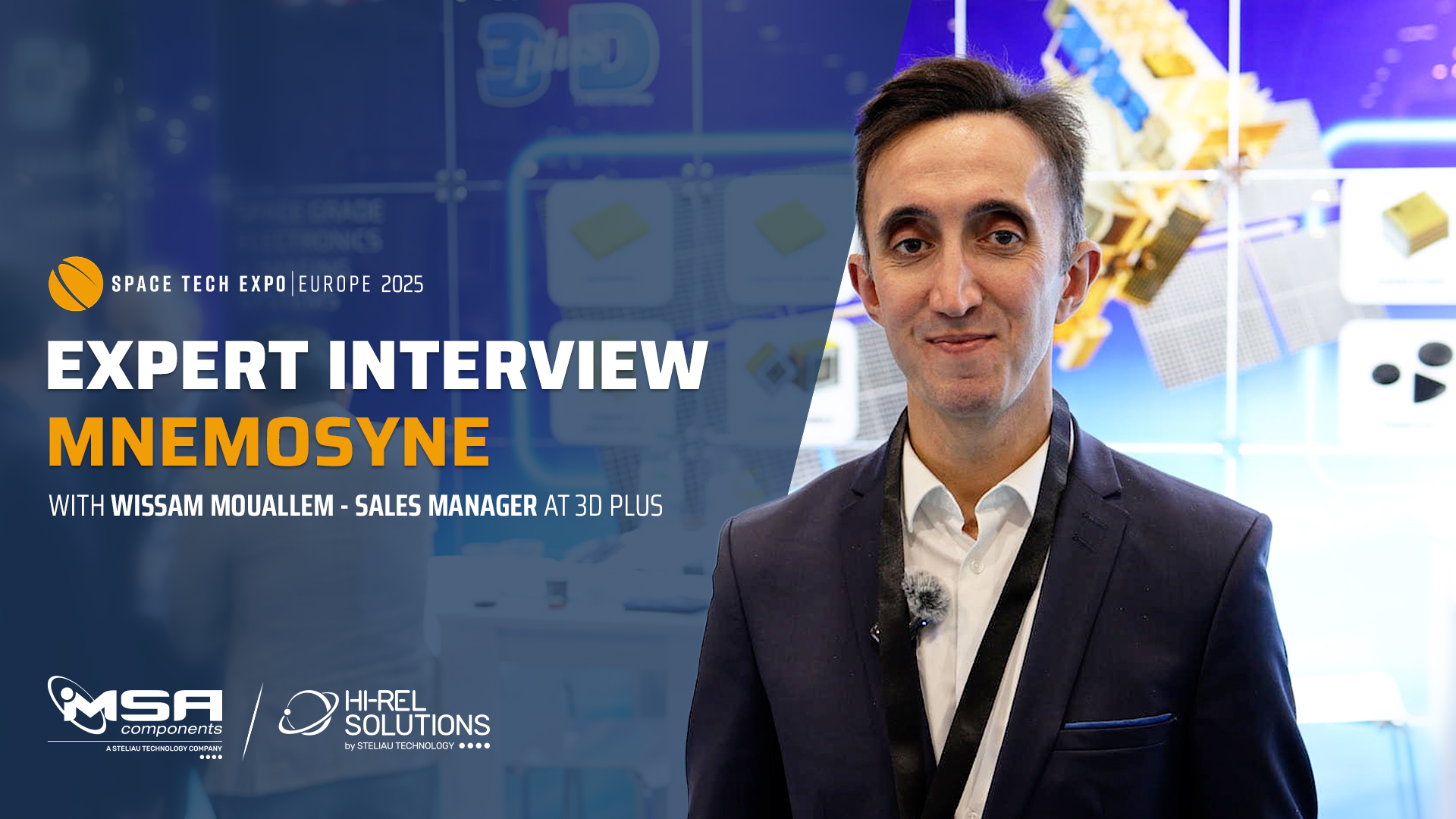
3D PLUS MNEMOSYNE: European STT-MRAM for FPGA Configuration in Space
FPGA configuration data and processor boot code must remain available even after a system has been powered down. In spacecraft electronics, radiation response, data integrity and long-term component availability add further requirements to non-volatile memory selection.
In our Space Tech Expo Europe 2025 interview, Wissam Mouallem, Sales Director at 3D PLUS, introduces MNEMOSYNE, a European-developed and manufactured family of radiation-hardened non-volatile memories based on STT-MRAM technology.
Non-Volatile STT-MRAM Based on 22 nm FDSOI Technology
MNEMOSYNE uses spin-transfer-torque magnetic RAM (STT-MRAM) implemented in 22 nm FDSOI technology. Its memory contents are retained without continuous power. 3D PLUS positions this technology for storing FPGA configuration images and boot code for processors in space systems.
The MNEMOSYNE family offers 128 Mbit, 512 Mbit and 1 Gbit variants. 3D PLUS provides both a parallel, EEPROM-like interface and serial SPI-based versions. Depending on the device, supply options include 1.8 V and 3.3 V. Device selection also depends on the supported interface modes and timing requirements of the specific part.
Radiation Performance, Data Integrity and Long-Term Storage
3D PLUS specifies total ionizing dose (TID) greater than 100 krad(Si) and embedded error-correction functions (ECC) for MNEMOSYNE. The operating-temperature range is −55 to +125 °C. The manufacturer also lists 100,000 program/erase cycles and 20 years of data retention.
For single-event-effects (SEE) assessment, the published radiation data need to be considered together with the selected memory variant, interface and operating mode. This is an essential part of aligning the component with the spacecraft’s radiation requirements.
European Manufacturing and Full Production
European manufacturing is a central theme of the interview. Wissam Mouallem explains that MNEMOSYNE, including its semiconductor dies, is manufactured in Europe. This can matter to space programmes considering procurement, traceability and supply-chain planning.
Since the interview, 3D PLUS has reported a further product milestone: according to the manufacturer, the MNEMOSYNE family has completed qualification and entered full production. This updated status adds to the technical picture presented in the 2025 conversation.
MNEMOSYNE and COMBO: Two Layers of FPGA Configuration
MNEMOSYNE provides standalone non-volatile storage based on STT-MRAM. COMBO, by contrast, manages FPGA boot and configuration images using integrated radiation-tolerant NAND Flash. In a separate interview, Mouallem discusses the role of this Configuration Memory Boot Manager. The two products address distinct aspects of FPGA system architecture.
Meet 3D PLUS at Space Tech Expo Europe 2026
Visit our co-exhibitor 3D PLUS at Space Tech Expo Europe in Bremen, 17–19 November 2026, Hall 5, Booth F11. Talk to the 3D PLUS team about MNEMOSYNE, non-volatile memory and radiation requirements for space applications.
Colleagues from MSA Components and Hi-Rel Solutions by Steliau Technology will also be there as our extended team for technical questions and project discussions.
Arrange a technical discussion with our team in Bremen:
3D PLUS MNEMOSYNE: European STT-MRAM for FPGA Configuration in Space FPGA configuration data and processor boot code must remain available even after a system has been powered down. In spacecraft…
3D PLUS COMBO: Boot Management and FPGA Reconfiguration for Space Applications In modern FPGA-based spacecraft systems, storing configuration data is only part of the challenge. Managing multiple bitstreams and the…
Omnetics: From Miniature Connectors to Custom Interconnect Assemblies How do engineers design a high-density interconnect when electrical requirements, limited space and mechanical loads all need to be considered? The connector…
Beyond Gravity: When Satellite Structures Also Serve Thermal Functions A satellite panel must carry mechanical loads, provide interfaces and remain functional under changing thermal conditions. What changes when the panel…
From component selection to design-in: our sales team advises you in person, by phone, video call or on site. We will set aside 30 minutes for you.
How
Phone, video call or on site
Where
At MSA in Attendorn or at your premises
Duration
Up to 30 minutes
Response
Within 1–2 working days
PERSÖNLICHE BERATUNG
Sprechen wir über Ihr Projekt
Von der Bauteilauswahl bis zum Design-in: Unser Vertriebsteam berät Sie persönlich, telefonisch, per Videokonferenz oder vor Ort. Wir nehmen uns 30 Minuten Zeit.
Wie
Telefon, Video oder vor Ort
Wo
Bei MSA in Attendorn oder bei Ihnen
Dauer
Bis zu 30 Minuten
Rückmeldung
Innerhalb von 1-2 Werktagen
Application Form
Bewerbungsformular
Produktinformationen anfordern
Interessieren Sie sich für dieses Produkt? Geben Sie unten Ihre Daten ein, und wir melden uns bei Ihnen mit Informationen zu Preisen, Verfügbarkeit und technischen Details.
Request Product Information
Interested in this product? Fill in your details below and we'll get back to you with pricing, availability, and technical information.