Beyond Gravity: When Satellite Structures Also Serve Thermal Functions
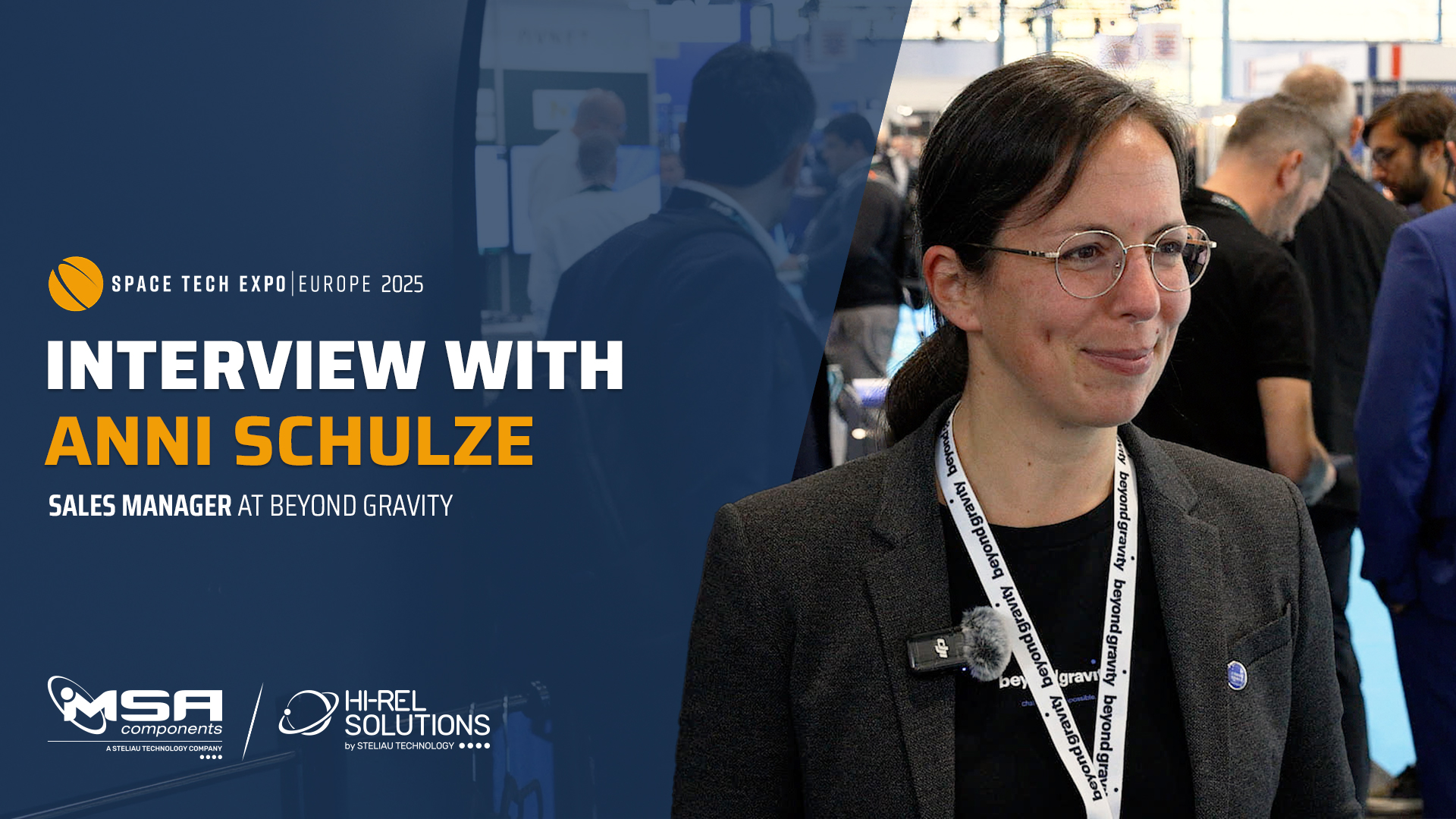
A satellite panel must carry mechanical loads, provide interfaces and remain functional under changing thermal conditions. What changes when the panel also becomes part of the thermal-control architecture? In our interview at Space Tech Expo Europe 2025, Anni Schulze, Sales Manager Mechanical Satellites Solutions at Beyond Gravity, uses a demonstration panel to explain the close relationship between structural design, thermal functionality and system integration.
In spacecraft development, electrical interconnects, mechanical interfaces and thermal architecture must be considered together. Schulze’s examples illustrate how structural and thermal requirements at panel level influence the design of the complete spacecraft.
Satellite panels: lightweight structures with different face-sheet materials
Beyond Gravity designs and manufactures satellite structures, including honeycomb sandwich panels with aluminum or carbon-fiber-reinforced face sheets. Material selection depends on mechanical requirements, mass, interfaces and the mission design. Its official product information describes different panel thicknesses, face-sheet materials and core densities for various spacecraft applications.
Schulze uses a panel displayed during the interview to demonstrate integration possibilities. She points to aluminum and carbon-fiber face sheets, thermal coatings and embedded heat pipes. These features cannot be assessed from material names alone. Heat-transfer requirements, mechanical coupling, installation constraints and verification of the actual design all matter. The interview does not provide validated performance specifications for the demonstrated panel, so no thermal-conductivity, temperature-limit or mass-saving figure is claimed here.
Thermal control and mechanisms in spacecraft architecture
Beyond Gravity also supplies multilayer insulation (MLI) for satellites, mechanisms and associated drive electronics. MLI limits radiative heat exchange and supports the thermal design of sensitive spacecraft subsystems. The manufacturer documents insulation systems supplied for European weather satellites and scientific missions.
For mechanical systems, Schulze refers to pointing mechanisms for applications such as antennas and electric propulsion thrusters. Beyond Gravity offers relevant product families, including two-axis electric propulsion pointing mechanisms and customized antenna mechanisms. Associated drive electronics provide defined actuator-control functions. Requirements vary with payload, propulsion system, interfaces and mission profile; published accuracy or lifetime figures should only be applied to their specified product variants.
Environmental verification: launch loads and vacuum conditions
Another key topic is testing and verification of components and assemblies. Schulze describes vibration tables and thermal-vacuum (TVAC) chambers. Beyond Gravity’s official testing-services information confirms these capabilities, including electrodynamic shakers for vibration tests and thermal-vacuum facilities with different chamber sizes.
These methods address distinct conditions. Vibration and shock testing investigate mechanical loads, including loads associated with launch. Thermal-vacuum testing combines reduced ambient pressure with defined thermal boundary conditions. It reproduces selected aspects of the space environment, not the entire orbital environment. Test profiles, limits and acceptance criteria must therefore be derived from the requirements of each mission and specific hardware configuration.
2026 project example: structural panels for Eutelsat OneWeb
A recent manufacturer announcement illustrates the application of this expertise at constellation scale. On 28 October 2026, Beyond Gravity reported delivering structural panels for 32 new Eutelsat OneWeb satellites. According to that announcement, the satellites were undergoing integration and launch preparation at Airbus in Toulouse at the time. The statement documents a delivery and integration milestone, not that these 32 satellites had already launched.
The example also illustrates a challenge of serial satellite programs: structural parts need both mission-appropriate engineering and reproducible manufacturing and verification processes. The public announcement does not identify the exact qualification or acceptance-test program applied to these particular panels.
What engineering teams should define early
For structurally and thermally integrated spacecraft assemblies, key requirements include load paths, mass and stiffness budgets, material pairings, thermal interfaces, cable routing, mounting concepts and mechanical and thermal verification. Integrating heat pipes, coatings or mechanisms into a structure also affects manufacturability, accessibility, assembly procedures and the qualification strategy.
Beyond Gravity at Space Tech Expo Europe 2026
Beyond Gravity is exhibiting independently at Space Tech Expo Europe in Bremen from 17 to 19 November 2026. The Beyond Gravity team will be pleased to welcome you at Booth V17 for discussions on satellite structures, thermal control and environmental testing.
You can also meet our extended team in Hall 5, Booth F11, with colleagues from MSA Components and Hi-Rel Solutions by Steliau Technology. We look forward to discussing your projects and technical requirements for high-reliability electronics.
Omnetics: From Miniature Connectors to Custom Interconnect Assemblies How do engineers design a high-density interconnect when electrical requirements, limited space and mechanical loads all need to be considered? The connector…
Beyond Gravity: When Satellite Structures Also Serve Thermal Functions A satellite panel must carry mechanical loads, provide interfaces and remain functional under changing thermal conditions. What changes when the panel…
ASTERIA by 3D PLUS: 4K imaging in a space camera weighing less than 70 grams An 8-megapixel CMOS image sensor, 4K video at 30 frames per second, and a camera…
3D PLUS: Why innovation in space electronics goes beyond miniaturization How much further can space electronics evolve when engineers challenge existing designs instead of simply improving them? At Space Tech…
From component selection to design-in: our sales team advises you in person, by phone, video call or on site. We will set aside 30 minutes for you.
How
Phone, video call or on site
Where
At MSA in Attendorn or at your premises
Duration
Up to 30 minutes
Response
Within 1–2 working days
PERSÖNLICHE BERATUNG
Sprechen wir über Ihr Projekt
Von der Bauteilauswahl bis zum Design-in: Unser Vertriebsteam berät Sie persönlich, telefonisch, per Videokonferenz oder vor Ort. Wir nehmen uns 30 Minuten Zeit.
Wie
Telefon, Video oder vor Ort
Wo
Bei MSA in Attendorn oder bei Ihnen
Dauer
Bis zu 30 Minuten
Rückmeldung
Innerhalb von 1-2 Werktagen
Application Form
Bewerbungsformular
Produktinformationen anfordern
Interessieren Sie sich für dieses Produkt? Geben Sie unten Ihre Daten ein, und wir melden uns bei Ihnen mit Informationen zu Preisen, Verfügbarkeit und technischen Details.
Request Product Information
Interested in this product? Fill in your details below and we'll get back to you with pricing, availability, and technical information.